Information
Substrates and Adhesion
Adhesives attach to the surfaces of two substrates, unlike
a process that fuses substrates into a unified whole such
as welding metal or solvent activation of plastics. In
selecting a 3M adhesive or tape, surface condition must
be considered: roughness, smoothness, porosity, coated,
uncoated, cleanliness, flexibility, size of the part and
surface energy of the part.
Adhesive paste, for example, flows readily into a rough
surface for improved effective adhesion. Flexible materials
such as paper or thin gauge metal can be bonded with a
thin adhesive transfer tape. Large rigid parts with smooth
clean surfaces can be bonded with a variety of 3M
products ranging from double coated foam tapes to two-
part structural adhesives. Some plastics have plasticisers
which migrate to the surface and degrade the bond over
time, so a plasticiser-resistant adhesive or tape is essential.
If the substrate has been powder coat painted, the coating
is the bonded surface rather than the substrate and you
Metals
Surface Energy Dynes/cm
Copper
1103
Aluminium
840
Zinc
753
Tin
526
Lead
543
Glass Porcelain
250-500
Stainless Steel
700-1100
HSE Plastics
Surface Energy Dynes/cm
Phenolic
47
Nylon
46
Alkyd Enamel
45
Polyester
43
Epoxy Paint
43
Polyurethane
43
ABS
42
Polycarbonate
42
PVC Rigid
39
Noryl
38
Acrylic
38
Polane Paint
38
LSE Plastics
Surface Energy Dynes/cm
PVA
37
Polystyrene
36
Acetal
36
EVA
33
Polyethylene
31
Polypropylene
29
Polyvinyl Fluoride
Film
28
PTFE Fluoropolymer
18
Powder Coatings
**
** Broad range of surface energy
Metal Surfaces
HSE Plastics
LSE Plastics
would want to consider a 3M tape or adhesive developed
specifically for that surface.
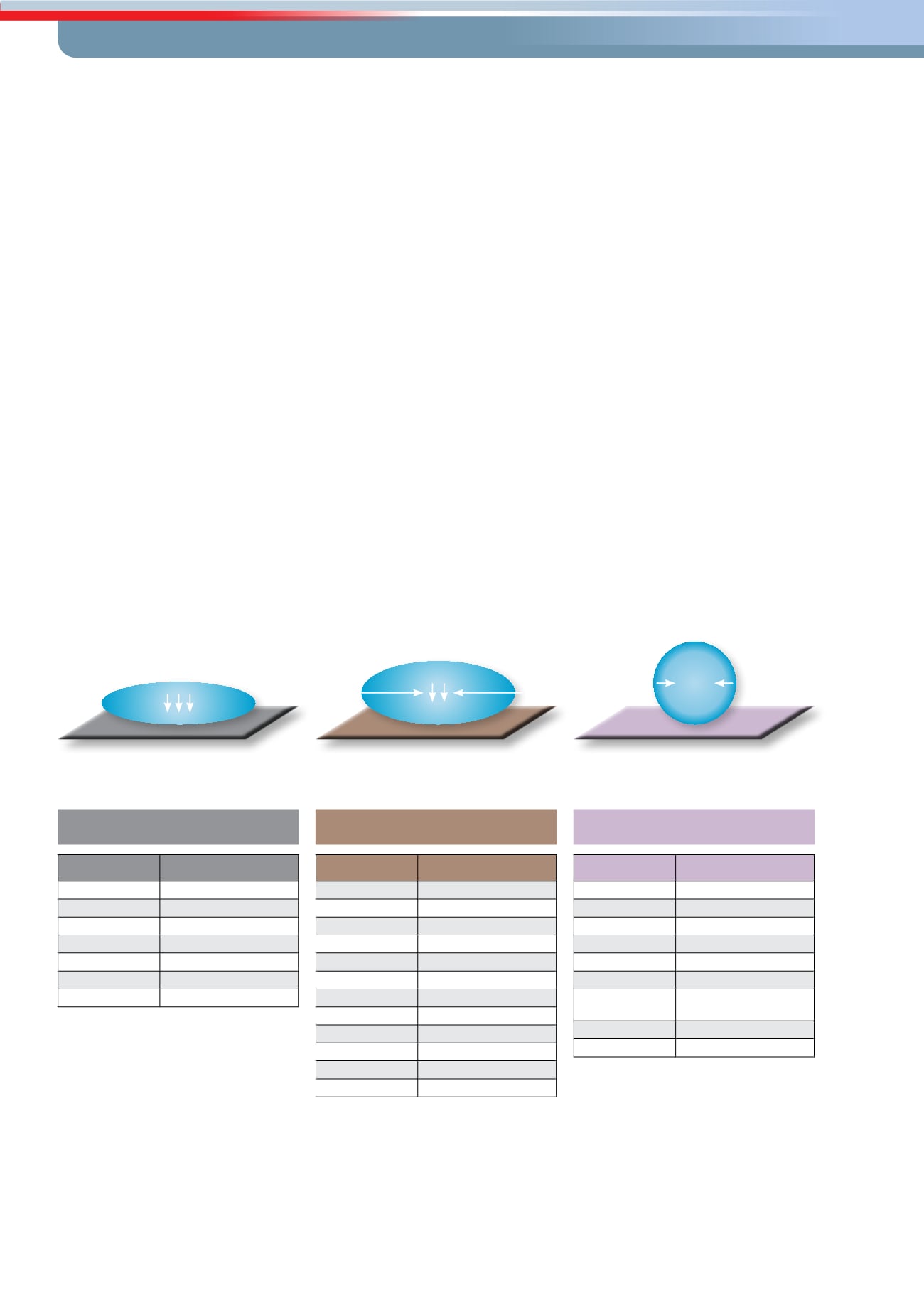
Surface energy ranges from high to low. To illustrate the
concept of surface energy, think of water on the unwaxed
bonnet of a car. The unwaxed bonnet has high surface
energy and water on the hood flows into puddles. In
comparison, a waxed hood has low surface energy and water
beads up rather than flows out. Similar to water, adhesive
on a high surface energy surface flows and “wets out” the
surface. “Wetting out” is required to form a strong bond.
As a rule of thumb, the higher the surface energy, the greater
the strength of adhesion.
Specially formulated adhesives are available for low surface
energy surfaces. The following illustrations and surface
rankings give you an idea of relative surface energy.
Regardless of surface energy, the substrate must be unified,
dry, and clean to maximise adhesive contact.
(High Surface Energy)
(High Surface Energy)
(Low Surface Energy)
28


