-
Asbestos Awarenesss month - Asbestos...the slow and silent killer.
November 12, 2018Asbestos...the slow and silent killer.
-
The majority of patients suffering from asbestos related illnesses learn about their disease when it’s too late and face a battle that is almost impossible to win. Often, they do not survive beyond two years after their diagnosis and it’s hard to imagine the impact that this largely preventable plague, often initiated many years earlier by minimal exposure, can have on the victims and their families.
November is Asbestos Awareness Month, during this period we aim to help raise awareness about the dangers of asbestos and how best to manage it. Below is an introductory article on asbestos, what it is and what it can do to you.
What is asbestos?
-
Asbestos is an umbrella term for a group of fibrous silicate minerals found abundantly in nature. In the past, it was widely used in commercial applications and construction because its structure makes it very heat resistant, great at insulating surfaces and easy to weave within other materials and products. Between 1945 and 1980 in Australia, asbestos was widely used in the construction industry, as well as in shipyards, power stations, boiler makers and plumbing. It was also extensively used in a variety of residential building products as well, in fibro cement, insulation, fireproofing, pipes, paint, floor coverings, ceiling tiles, and roofing materials.
There are two main types of asbestos, Serpentine and Amphibole. Serpentine fibres are long, flexible, and curved, which makes them popular in manufacturing. Amphibole fibres are straight and stiff, and that makes them brittle and more liable to break. It’s precisely when these bundles of fibres break that your lungs become at risk.
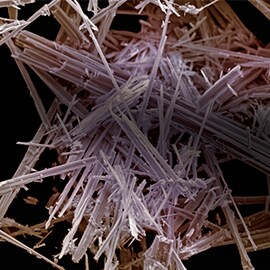
When asbestos containing materials are disturbed, this is when the asbestos within these materials can break into tiny fibers that are too small to see, feel or taste. The image to the left depicts asbestos fibres under magnification.
When am I at risk?
Repeated and long-term exposure to asbestos has been generally linked to asbestosis, whereas lung cancer and mesothelioma may be caused by once off exposure. However, this product does not discriminate as it spreads its tentacles leaving a path of destruction wherever it rears its ugly head. There is no safe threshold level of exposure to asbestos fibres. It’s critical that you learn about the dangers of asbestos, where it can be found and how to manage it safely.You’re likely to potentially inhale asbestos fibres when asbestos containing materials are damaged or disturbed. This is a much higher risk with friable asbestos as it can more easily be broken down releasing asbestos fibres into the air. Friable asbestos is more common in industrial environments than residential properties, but still may be present as loose fill asbestos insulation. Non-friable asbestos may be found in both industrial and residential environments and was commonly used in roofing materials, floor tiles, insulation materials, heating systems, electric and sound insulation products, automobile friction materials such as clutch pads, and many more.
Image Source: asbestosawareness.com.au.
What can I do to protect myself?
Know where to look - Asbestos can be found in many forms and in many materials. If your house was built before the 1990’s it is likely that there will be some asbestos containing materials in that property. If your property was built in the 1950s-1960s then it is highly likely it will contain asbestos containing materials. The asbestos awareness website provide pictures and resources on some of the various potential asbestos containing materials. If you think it may contain asbestos, treat it as if it does, until confirmed otherwise.Use the right safety procedures and equipment - Given the popularity and pervasive presence of asbestos, it’s particularly important to have the right protective gear within reach at all times any time there’s potential risk for exposure and to follow the correct working procedures, which can be found at www.asbestosawareness.com.au or any of the state or territory regulators. When it comes to respiratory protection, an AS/NZS 1716 compliant respirator featuring a particulate filter should be worn.
Safety starts with you!
Asbestos is highly toxic, causing a range of lung diseases that are slow to develop but in many cases deadly. While the product has been banned and its use prohibited it is still prevalent and may be lurking where you least suspect it. Whether you work in the construction industry, handle insulation products, install roofs and tiles, manipulate clutch pads or are taking on ambitious home renovations, asbestos could pose a serious threat for your lungs and overall health. The removal of asbestos materials should always be performed by a licensed professional asbestos removalist. However, when renovating or performing maintenance around the home you may come across asbestos containing materials so it’s particularly important you use the correct Personal Protective Equipment at all times.When it comes to asbestos, Go Slow! Asbestos - it’s a NO GO! Visit www.asbestosawareness.com.au to learn what you need to know or reach out to a 3M Safety Specialist if you’re unsure of any aspect of PPE required to safeguard you against potential asbestos hazards.
Below is a selection of educational resources and product solutions related to asbestos awareness and safety.
Asbestos PPE Solutions
-
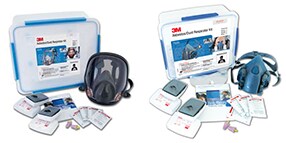
Asbestos/Dust Reusable Respirator Kits
Convenient respiratory kits designed for asbestos removal and environments containing dust. Kits come complete with either a full face or half face respirator, particulate filters, cleaning wipes and earplugs. Packed in a durable protective case that also aids decontamination practices. For full kit contents and details refer to:
Full Face Kit
Half Face kit -
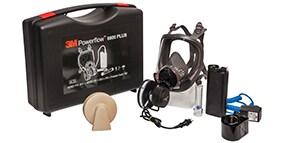
Powered Air Purifying Respirator
The 3M™ Powerflow 6800 Plus Powered Air Purifying Respirator (PAPR) uses a wide view silicone faceseal full facemask connected to a turbo/filter unit. This product may be used in environments where significant levels of fibres are routinely present in the workplace atmosphere. A typical example of such an environment is the removal of friable asbestos and asbestos containing materials.
-