-
Into the darkness...lucky to be alive.
February 28, 2019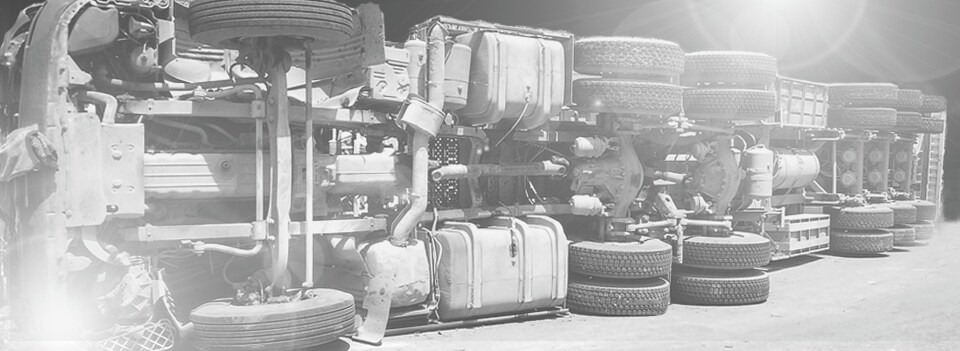
Into the darkness...lucky to be alive.
Imagine driving down a dark desert highway, there are no street lights, the new moon is hidden, it’s pitch black. You are not distracted, your mind is clear and you are focussed on the task at hand....driving. No texting, no phone calls, no loud music, just sheer concentration as you count down the hours till you reach your destination. You’ve heard too many disturbing stories about highway accidents and you just want to get home safely, to your family. As your favourite podcast keeps you company on your journey you estimate that you’ll be home in around four hours, just as the family rise from their slumber. As you focus on the long and lonely stretch of darkness ahead you start to picture the joy in the faces of your smiling toddlers when they see you, it’s the first time you’ve been away from them for such a long period of time. You plan to take a rest stop in another hour or so, just the thought of smelling that freshly ground coffee gives you a new sense of awareness.
“In a matter of seconds, lives can be irreversibly altered.”
Suddenly, out of nowhere, the silence erupts with the deafening sound of crushing metal and cracking glass. The sounds of your own screams are drowned out by the exploding air bag that knocks you back with a mighty force causing your ears to start ringing, bones to crack and leaving you gasping for air. Then as abruptly as the chaos ensued, silence fills the air again as the overwhelming odour of toxic petrol fumes waft into the cabin. As you drift in and out of consciousness you realise the extent of the carnage thrust upon you, unaware of how it happened. Terrified you realise that you are pinned by the steering column that has been pushed into your chest, you can’t feel your legs and blood drips down your aching head and into your mouth as it bows to the pressure of the collapsing roof.
In a moment of consciousness and divine intervention you glance upon your phone, with all the strength you can muster and the skill of a contortionist you stretch your bloodied arm and reach for your phone, after many fumbled attempts you finally have it securely in the palm of your hand. Through the corner of your eye you manage to make out the home button and with an almighty force press the home button then tap emergency at the bottom of the screen.
Time: 02:59:42
Duration: 2 min, 30 secEmergency Operator: Emergency - police, fire or ambulance? Caller: Umm, ambulance. Emergency Operator: Where is your emergency? Caller: I’m on the highway, please help me. Emergency Operator: What is the address? Caller: Umm, I‘m not sure, I’m on the highway heading home. Emergency Operator: What is the problem, tell me exactly what happened? Caller: I don’t know, I think I hit a brick wall, I can’t feel my legs, there’s blood everywhere, please help! Emergency Operator: What is your name? Caller: David. Emergency Operator: David, this is Sandy, there are no brick walls on the highway, did you hit the barrier, a tree, a kangaroo? Caller:I don’t know, I didn’t see anything, I was driving on a straight stretch of road then I just ran into a wall, I think its a wall, there’s bush all around me, the air bag has activated the windscreen is shattered, I’m covered in blood. I can’t move, I cant feel my legs, please send help, I think I’m going to pass out. Emergency Operator: David, what’s your exact address? Caller: I don’t know, I’m on the highway. Emergency Operator: David, do you remember the last sign you saw? Caller: Umm, I think it said, umm, I don’t know. Please help me, I cant feel my legs. Emergency Operator: David, what is the number you are calling from? Caller: Please help, help! (shouting). Emergency Operator: David, stay calm, I need your number, what is your number? Caller: I think I’m going to pass out. Emergency Operator: David, stay with me, David are you there? David? David? 
Wrong place, wrong time.
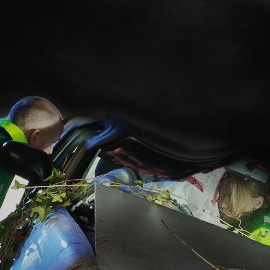
As you awaken from your unconscious state you are blinded by the number of bright and flashing lights as you hear a comforting voice above the sounds of machinery humming in your ears. “David, we’re here buddy, don’t move, the paramedics have you stabilised and we’re cutting you free from the wreckage.” “Where am I?” you shudder in a faint voice. “I need to get home, I need to see my kids.” “Try to Relax David, you’ve been out for a while, you’re one lucky man, you’re going to be OK, we’ll have you home soon.” “Can you tell me what happened to me?” whispered David, struggling to speak as tears stream down his face. “There was an overturned truck across the highway, its electrical system was out and it just blended into the darkness, you might as well have been as blind as a bat, there was no way you could have seen it and avoided the collision. Unfortunately you were just in the wrong place at the wrong time.”
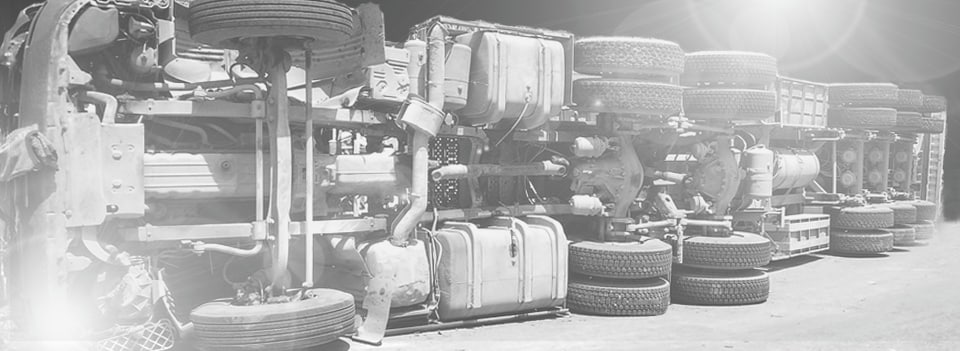
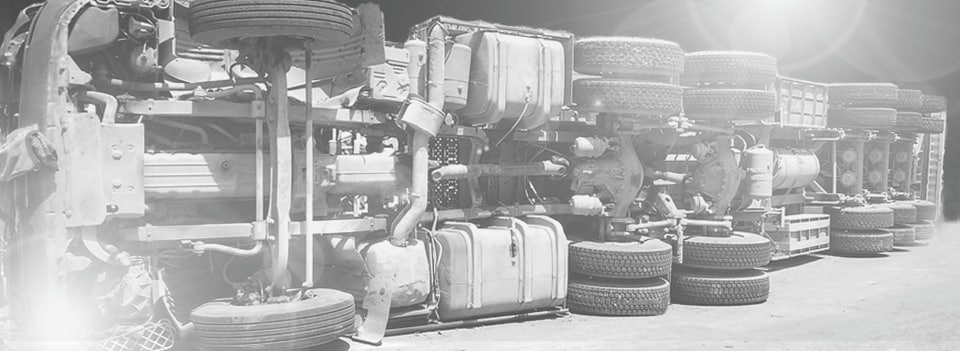
Does the scenario above sound far fetched? Admittedly the above is a piece of fiction to illustrate the seriousness of vehicles becoming invisible on our roads. Incredibly, however, in October 2018 a truck had overturned blocking both lanes of the Eyre highway in Western Australia, the truck’s underside blended into the pitch black road and there were no lights working on the damaged vehicle. Unfortunately, 30 minutes later, a vehicle travelling at 110km/h slammed into the overturned truck, the driver had no time to react to avoid the accident as the vehicle did not become visible until the impact occurred. Luckily he survived, after being trapped in his vehicle for more than two hours he was eventually airlifted to Perth where he remained in hospital for seven days. Since his accident he has campaigned for an emergency lighting system to trigger in the event of a crash, or for something as simple as a reflective item installed to the underside of heavy vehicles.1
Heavy vehicle safety is a serious issue.
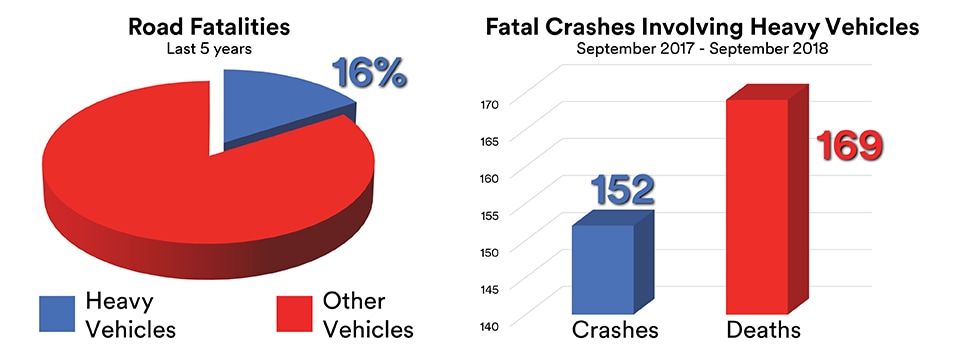
While the numbers of heavy vehicles on our roads in comparison to the total number of motor vehicles make up a small percentage, heavy vehicles have been involved in 16% of all road fatalities.2 In Australia alone, during the last 12 months to the end of September 2018, 169 people died from 152 fatal crashes involving heavy trucks.3
Heavy vehicles may not have always been at fault in these accidents, however due to their stature and bulk they make any collision a serious concern. The ability to readily see and identify a heavy vehicle, as illustrated in both the fictional and non-fictional tragic events above highlight the importance of vehicle visibility, from all angles, particularly in low light and low visibility conditions. As we stand today we have two options available to heavy vehicles to increase their conspicuity, that is, their ability to draw attention to other road users to their presence, regardless of whether or not they are actively looking out for them. We have lamps in the form of marker or running lights, or retroreflective markings.
Whilst many heavy vehicles are fitted with standard marker or running lights that are visible in darkness, they are rendered inoperative in the event of an accident where the electrical circuitry is wiped out and these lights have no effect. They also do not operate when the vehicle is parked along the roadside or broken down. Typically these lights are the responsibility of the driver and the owner of the vehicle who need to ensure they are maintained and function correctly, however non-working lights may not always be detected and drivers may head out onto the open roads unaware. Be that as it may, these lights can be effective as daytime running lights, studies suggest that they increase the probability that a vehicle will be detected when ambient lighting levels are low, on shady roads or those with backgrounds that have the ability to mask objects in the foreground, thereby reducing daytime crashes.
Retroreflective markers indicate the presence of a heavy vehicle when viewed from the front, side and rear by reflection from a light source emanating from an approaching vehicle. Markings are applied as close to the edge of the vehicle as possible to form a continuous line, depicting the contoured outline of the vehicle. This provides maximum visibility to other road users, increasing visibility for improved safety by up to 30 times.4 Heavy vehicles with reflective trailer tape are easier to see from afar, giving drivers a greater ability to see the reflected colour and recognise them with more time to manoeuvre. Retroreflective markings have the added advantage that they do not rely on a power source, so apart from being pretty much maintenance free, a broken down vehicle that has lost power or is simply parked on the side of the road, or one that has overturned and strewn across a highway may be visible to oncoming traffic.
The powers of two.
So what is the answer? The conspicuity of heavy vehicles on our roads at all times is a major factor in road safety, for all road users. So how do we enhance it? Could it be that combining the powers of two individual solutions, the benefits of both marker lights and retroreflective markings joining forces to provide a practical and effective strategy for heavy vehicles on our roads?
“People will react first to that which is most visible and colour plays a central role in allowing us to detect objects quickly, thus allowing more time to react to and avoid a hazard.”5 The powers of two! A creative relationship where the ‘one-size fits all’ approach is set aside and two individual solutions work together to save lives on our roads...after all, heavy vehicles need to provide as much visibility as possible, 100% of the time.
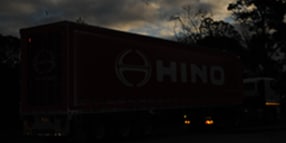
Danger
No reflective tape and marker lights make the truck virtually invisible.
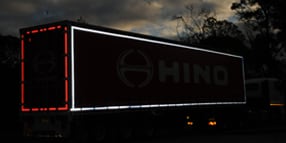
Safe Zone
Reflective tapes provide 24/7 visibility, even when the power is turned off.
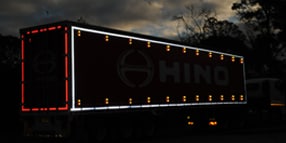
The Power of 2
Combining marker lights and reflective tapes create best practice safety.
Don’t leave safety to chance.
3M is dedicated to improving traffic safety and mobility on a global level by offering a portfolio of solutions to help get everyone home safely. For over 75 years we have made roadways safer and protected drivers. Our range of 3M™ Diamond Grade™ Conspicuity Markings allows vehicles to be seen earlier than unmarked vehicles, allowing for considerably longer reaction times Whether you need to add visibility to emergency vehicles, trucks and trailers, buses or rail cars, there’s a 3M solution to fit your needs, backed by local technical support and certified applicators helping you to comply with regulations and guidelines.
Whether you’re an engineer, fleet owner, asset manager, local council or manufacturer, don’t leave safety to chance. Choosing a 3M Reflective Certified Partner ensures that you are using a compliant and genuine 3M product that meets or exceeds all applicable standards. Contact your local 3M Reflective Certified Partner to find out more about the complete range of UN Standard reflective tapes for heavy vehicles.
For more information about conspicuity markings for heavy vehicle applications explore our 3M™ Diamond Grade™ Conspicuity Reflective Technology brochure, or contact your 3M Transportation Safety Expert.
References:
1. Christien de Garis, 21/10/2018, ‘Driver survives slamming into overturned truck on dark Nullarbor highway’, ABC News, accessed 7/12/2018, (https://www.abc. net.au/news/2018-10-21/driver-survives-high-speed-nullabor-crash/10398240)
2. Heavy truck safety: crash analysis and trends Information Sheet 78: Department of Infrastructure, Regional Development and Cities - Bureau of Infrastructure, Transport and Regional Economics.
3. Fatal Heavy Vehicle Crashes Australia Quarterly Bulletin Jul-Sep 2018, Department of Infrastructure, Regional Development and Cities.
4. Prof. Dr. –Ing. H.-J. Schmidt-Clausen, Laboratory of Lighting Technology, Darmstadt University of Technology: Contour Marking of Vehicles, Final Report FO 76/00.
5. Stephen S. Solomon, 1999, ‘Emergency vehicle accidents: prevention and reconstruction’, P 71.